
Embodiment Coaching Certification
Coach beyond just words by working with the body
A 6-month live online training for coaches, facilitators and therapists who want to work with the body safely and practically.
Train presence, state, boundaries and body-based tools. Live practice, accountability, feedback and peer support.
Starts September 15
2000+ coaches trained
15+ years experience

Students from 40+ countries
84% graduation rate
“CEC had a huge impact by giving me tools that made my coaching so much more powerful.” – Fabiana Legradic, Coach (Switzerland)
What coaching needs now
Coaching is not short of models, questions, scripts or advice.
AI can generate those in seconds. So can coaching books, LinkedIn posts and people who have recently discovered the word “powerful”.
What is harder to train is presence, timing, trust and the ability to notice what is happening in the client, in yourself and in the relationship.
That is the bit CEC trains.
Through the body, insight becomes something clients can actually use under pressure.


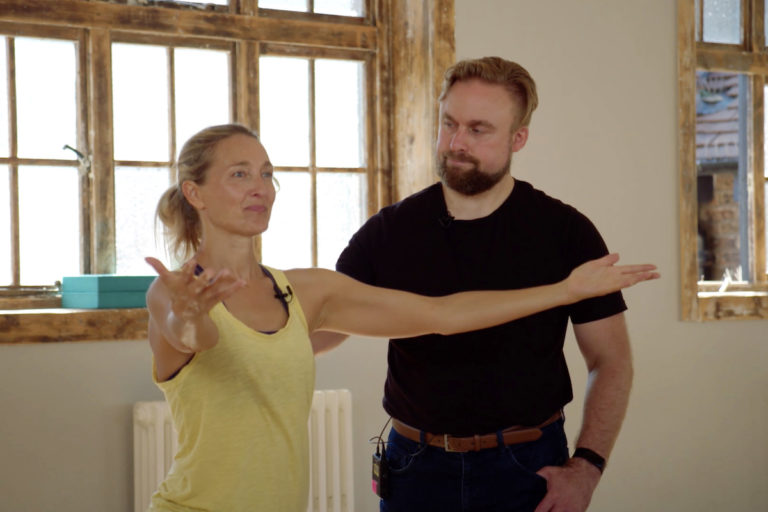
Why embodiment changes coaching
Many clients can talk endlessly about their patterns.
They can explain the family system, the leadership problem, the relationship dynamic, the productivity issue, the childhood wound, the attachment style… Frankly, the whole bloody TED Talk.
But under stress, the body does something else.
They freeze. Collapse. Mask. People-please. Overthink. Push through. Shut down. Say yes while something in them is clearly saying no.
This is not because they are broken or “resistant”.
Often, their patterns live their embodiment – posture, breath, attention and nervous-system habits.
Talking brings insight. But the body makes change usable under stress.
CEC helps coaches work with that layer safely and practically – within coaching scope, without pretending to be therapists, and without making embodiment weird for the sake of it.

Embodiment changes what is possible
When clients are stressed, collapsed, frozen or over-activated, they do not have access to the same choices.
Coaching needs to include the state they are actually in.
Patterns live in the body
Habits show up in posture, breath, movement, attention, tone and relational response.
The story is only part of the pattern.
The body gives clients something to practise
Instead of only talking about confidence, boundaries or presence, clients can rehearse them through simple embodied exercises.
This has to be practised

You can read about embodiment and watch videos about centring.
Shelf-help is useful… sometimes.
But presence is trained live.
So is timing, consent and knowing what to do when something real happens in a session.
In CEC, you practise, get feedback, watch demos, work with peers and meet clear standards.
That is how the work gets into your body.
Is CEC right for you?
CEC is aimed at people who already work with people – coaches, facilitators, trainers, therapists who coach and body-based practitioners – and want to bring the body into that work safely.
It also suits people who want a clear path to becoming certified embodiment coaches.
You do not need to be bendy, mystical or enlightened.
You do need to practise, be seen, get feedback and take the work seriously.
Good fit if you…
- Know talking alone has limits
- Want practical body-based tools for client work
- Want more presence, state and boundary skill
- Care about consent, safety and coaching scope
- Are willing to practise with other people
- Can make room for live calls, peer practice and work between sessions
Probably not if you want…
- Passive content only
- Quick tricks
- Therapy training
- Personal healing as the main focus
- A certificate without practice
- Vague embodiment with no standards
- Constant affirmation instead of useful challenge
How we work here
CEC is not for everyone.
That’s a good thing.
You will practise with other people. You will get feedback. You will be asked to notice your own state, your habits and the effect you have in the room.
Consent matters. So does kindness and being able to hear something useful without needing it wrapped in cotton wool.
CEC is not ideological purity training or spiritual theatre.
You are responsible for your state, your learning and your behaviour.
If you want to be supported and challenged, you may love it.
If you want to be constantly affirmed, rescued or agreed with, you probably won’t.
What changes for graduates
CEC gives you tools you practise, not ideas you politely collect.
You work with real coaching situations, get feedback, and learn to bring the body into client work without losing your head or your professional scope.
The work shows up in your timing, your boundaries and the choices you make in real-time under pressure.
By the end, you should be able to use simple body-based tools in coaching sessions, stay inside scope, and meet clear assessment standards.
In you
- Stay steadier when a session gets real
- Trust your body as part of your coaching instrument
- Notice your own state before it runs the room
- Hide less behind clever questions
In your client work
- Help clients shift state, not only analyse patterns
- Use breath, posture, attention and boundaries cleanly
- Work with overthinking, freezing, collapsing and people-pleasing
- Stay in coaching scope while bringing the body in

Trea Pluister-van Til
“I have used the tools and techniques with clients to enable a deeper awareness and different choices.”
Steve Litchfield
"A total game-changer for my coaching practice. It’s by far the most valuable training investment I’ve made."

Marie Antonette Valderrama
“CEC has given me the power and authority to transform the lives of many Filipinos for the better!”
How the training works
Unfortunately, you do not learn embodiment by thinking harder about embodiment.
CEC is live and practical. You are taught the tools, shown them in action, then asked to practise.
You get feedback. You try again.
This is how skill develops.
You try the tools in your own body first. Then you practise bringing them into coaching, facilitation and client work.
The point is skill, not information-hoarding.
CEC is a 6-month, live online course starting September 15.
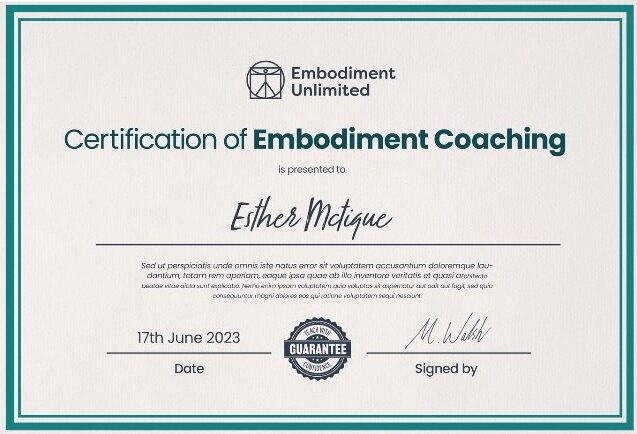
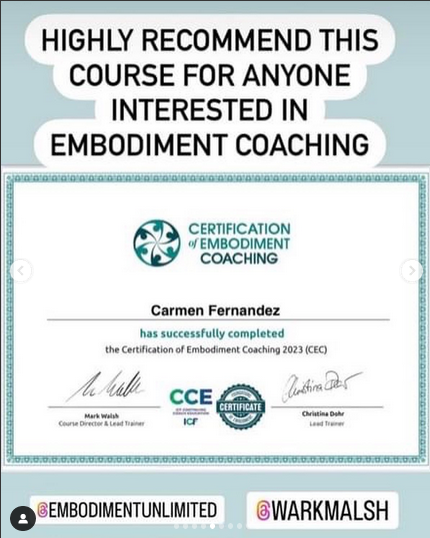
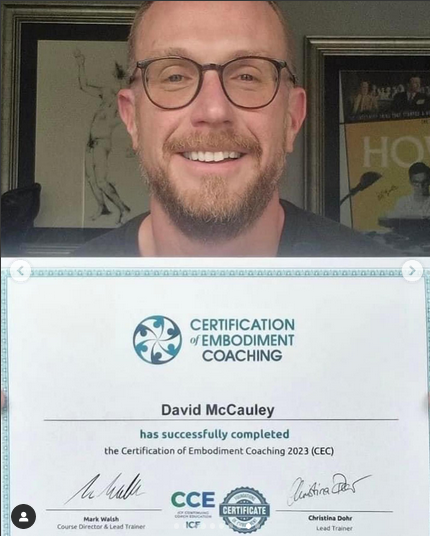
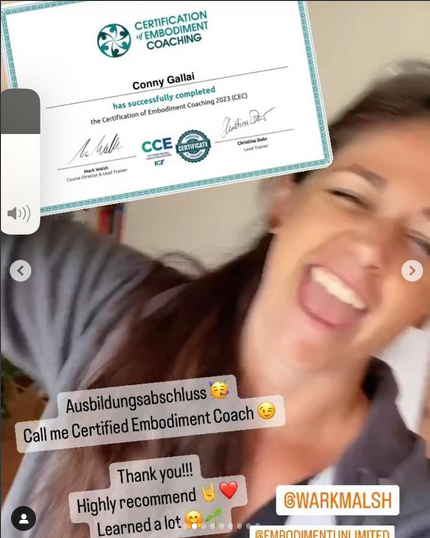
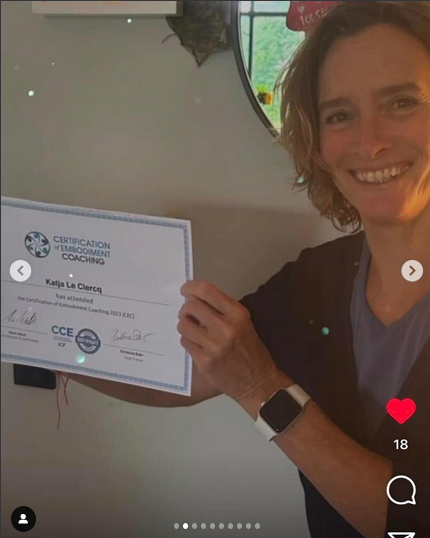
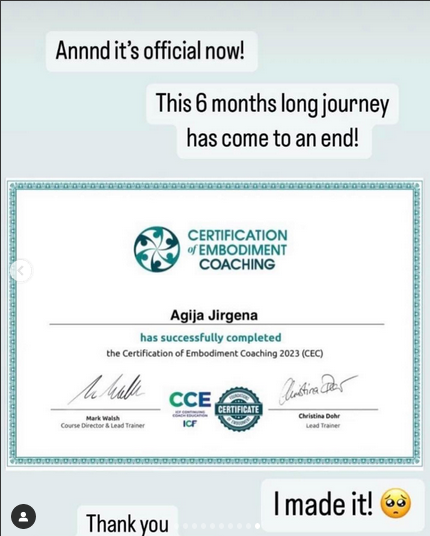
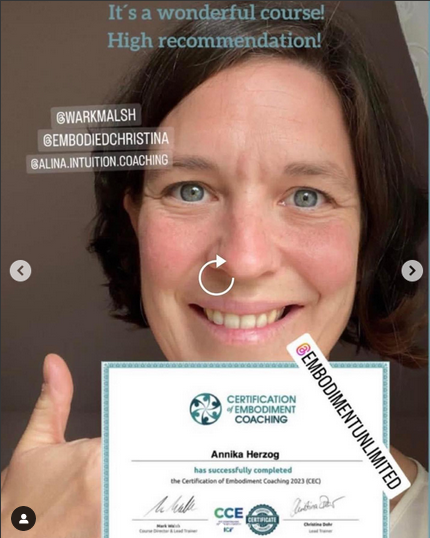
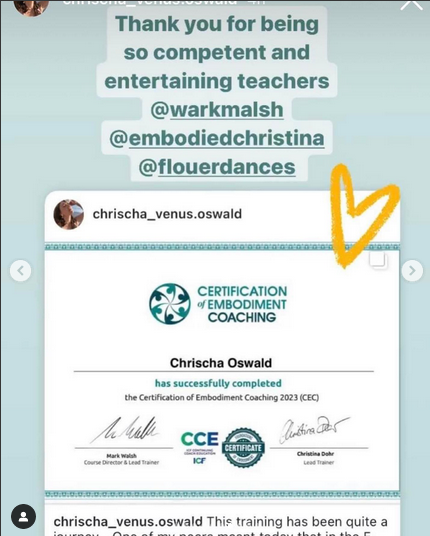
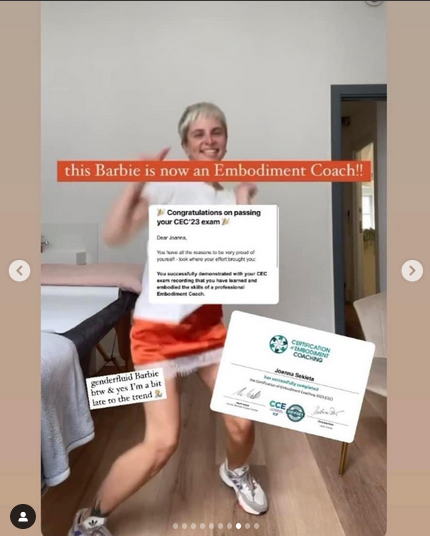
Upon graduation you will receive the Certification of Embodiment Coaching along with 37 ICF CCE hours.
Key details
Start date: September 15
Format: live online
Length: 6 months
Recognition: 37 ICF CCE hours
Live attendance: 80% of Tuesday calls required
Time needed: around 5-6 hours per week
Weekly rhythm
Tuesday live training calls
75 minutes.
There are three Tuesday time options, and attending any one of them counts toward your live attendance.
Thursday calls
60 minutes.
Highly recommended for extra support, practice and integration.
Weekly peer group
Required.
This is where some of the work gets into your body.
Recordings
You’ll have recordings access while we host the training platform.
Teaching and demos
You learn the models and tools, then watch how they are used with real coaching situations.
Practice
You try the work in your own body and practise with other students.
Feedback
You get seen, supported and corrected so the work becomes cleaner.
Standards
You are expected to show up, practise and meet the completion requirements.
How the six months unfold
Six months gives the work time to move from interesting idea to something you can actually do.
The detailed curriculum is below. This is the broad arc.

Phase 1:
Build your embodied foundation
You start with your own embodiment.
Presence, state, centring, awareness and range. How your embodiment affects the room.
Before you use this work with clients, you learn to notice what is happening in yourself.

Phase 2:
Bring the body into coaching
You learn practical ways to work with breath, posture, movement, attention, boundaries and state.
You practise using embodiment in coaching conversations without becoming vague, dramatic or weirdly theatrical.
This is where tools become usable.
Phase 3:
Integrate the work
You practise with more real coaching situations, including client work as the course progresses.
You also get feedback so that by the time you graduate you’ll have the range and skills to be a safe and effective coach.
Designed so you finish
CEC is not built as a content library you slowly avoid.
It has a weekly rhythm, peer groups, live attendance, feedback, a course manager and clear assessment standards.
That matters.
Busy adults do not usually finish training because they are magically disciplined. They finish because the structure keeps them engaged.
What keeps you engaged
- Three Tuesday time options
- Weekly peer group
- Live practice and feedback
- Recordings when life happens
- Clear assessment criteria
- Course manager and team support
- 80% live attendance requirement
Clear standards, clear reassessment
If you show up and do the work – attend, practise and submit the required assessments – and your coaching is not yet at certification standard, we will give you clear feedback and a straightforward route to re-assess.
You do not just get waved through.
You also do not get left guessing.
That is the point of having standards.
What embodiment leaders say

Gabor Maté, MD
“Embodiment is an essential component of healing, and Embodiment Unlimited does valuable work bringing its importance to the public.”

Gabor Maté, PhD
“Challenges to our safety make us strangers in our own body. Embodiment Unlimited provides important resources informing individuals about practices leading to an effective ‘re-embodiment’.”

Jamie Catto
“The embodied work Mark and the team do is both creative and practical.”
Embodiment does not mean anything goes
Working with the body is powerful.
That is why CEC takes consent, scope and ethics seriously.
You learn to bring the body into coaching cleanly: with permission, clear boundaries, attention to capacity, and respect for what is yours to work with.
CEC trains coaches.
You learn when to work, when to slow down, when to stop, and when to refer.
The body is part of the work. It needs care, not drama.
Consent
Ask. Explain. Offer choice. Respect a no.
Scope
Work as a coach. Know what belongs in coaching and what does not.
Capacity
Notice when something is too much, too fast or not appropriate.
Referral
Know when the best coaching move is to send someone to the right professional.
You do not learn this alone in your head

Embodiment is relational.
In CEC, you practise with other students, work in smaller groups, bring the tools into client practice as the training progresses, get feedback, and notice what happens in your own body when you coach, listen, lead, freeze, rush or try to be impressive.
The community is not there for vibes.
It is there because this work needs other humans.
Learn from people who actually do the work
You see the work taught, demonstrated and picked apart.
You learn what the trainer noticed, why they chose a move, what they ignored, and how to keep the work clean.
This is one of the reasons CEC is live. Embodiment is easier to talk about than to do well.
Live teachers and support team

Mark Walsh
Founder of Embodiment Unlimited
See bio
Mark Walsh is the founder of Embodiment Unlimited and has spent more than 15 years training coaches, facilitators, leaders and practitioners in practical embodiment.
He is known for making embodiment useful, clear and occasionally inconvenient for people who like their personal development heavily perfumed.
His work brings together coaching, martial arts, trauma awareness, leadership training, meditation, movement and a long-running suspicion of vague spiritual waffle.

Christina Dohr
Embodiment Coach & Somatic Educator
See bio
Mark Walsh is the founder of Embodiment Unlimited and has spent more than 15 years training coaches, facilitators, leaders and practitioners in practical embodiment.
He is known for making embodiment useful, clear and occasionally inconvenient for people who like their personal development heavily perfumed.
His work brings together coaching, martial arts, trauma awareness, leadership training, meditation, movement and a long-running suspicion of vague spiritual waffle.

Carolina Padilla
Leadership & Wellbeing Coaching
See bio
Mark Walsh is the founder of Embodiment Unlimited and has spent more than 15 years training coaches, facilitators, leaders and practitioners in practical embodiment.
He is known for making embodiment useful, clear and occasionally inconvenient for people who like their personal development heavily perfumed.
His work brings together coaching, martial arts, trauma awareness, leadership training, meditation, movement and a long-running suspicion of vague spiritual waffle.

Dr. Kandis Lock, ND
Health & Trauma-Aware Coach
See bio
Mark Walsh is the founder of Embodiment Unlimited and has spent more than 15 years training coaches, facilitators, leaders and practitioners in practical embodiment.
He is known for making embodiment useful, clear and occasionally inconvenient for people who like their personal development heavily perfumed.
His work brings together coaching, martial arts, trauma awareness, leadership training, meditation, movement and a long-running suspicion of vague spiritual waffle.

Flouer Evelyn
Embodiment Facilitator & Dance Teacher
See bio
Mark Walsh is the founder of Embodiment Unlimited and has spent more than 15 years training coaches, facilitators, leaders and practitioners in practical embodiment.
He is known for making embodiment useful, clear and occasionally inconvenient for people who like their personal development heavily perfumed.
His work brings together coaching, martial arts, trauma awareness, leadership training, meditation, movement and a long-running suspicion of vague spiritual waffle.

Ranko Čerić
Aikido 4th-Dan, Trauma-Aware Coach
See bio
Mark Walsh is the founder of Embodiment Unlimited and has spent more than 15 years training coaches, facilitators, leaders and practitioners in practical embodiment.
He is known for making embodiment useful, clear and occasionally inconvenient for people who like their personal development heavily perfumed.
His work brings together coaching, martial arts, trauma awareness, leadership training, meditation, movement and a long-running suspicion of vague spiritual waffle.

Vanessa Schulz
Burnout Prevention Coach
See bio
Mark Walsh is the founder of Embodiment Unlimited and has spent more than 15 years training coaches, facilitators, leaders and practitioners in practical embodiment.
He is known for making embodiment useful, clear and occasionally inconvenient for people who like their personal development heavily perfumed.
His work brings together coaching, martial arts, trauma awareness, leadership training, meditation, movement and a long-running suspicion of vague spiritual waffle.

Alina Brand
Intuition Coach
See bio
Mark Walsh is the founder of Embodiment Unlimited and has spent more than 15 years training coaches, facilitators, leaders and practitioners in practical embodiment.
He is known for making embodiment useful, clear and occasionally inconvenient for people who like their personal development heavily perfumed.
His work brings together coaching, martial arts, trauma awareness, leadership training, meditation, movement and a long-running suspicion of vague spiritual waffle.

Dr. Helen Machen-Pearce
Nervous System Educator
See bio
Mark Walsh is the founder of Embodiment Unlimited and has spent more than 15 years training coaches, facilitators, leaders and practitioners in practical embodiment.
He is known for making embodiment useful, clear and occasionally inconvenient for people who like their personal development heavily perfumed.
His work brings together coaching, martial arts, trauma awareness, leadership training, meditation, movement and a long-running suspicion of vague spiritual waffle.
Why we run CEC...
“I keep running CEC because this is the work I care about most: training coaches who can actually use embodiment with people, not just talk about it.
CEC is for people who want to take this seriously – not post about embodiment, perform it, or use it as a spiritual status-grab.
The world needs more sane, kind, embodied people. Coaches can help with that… if they have the skills.
The training is practical, playful and sometimes challenging. We are not especially interested in pretending all ideas are equally useful.
You will practise.
You will get feedback.
You will be asked to look at your own patterns.
You may also laugh occasionally, even if the jokes are really bad.
If you want something ultra-spiritual, endlessly abstract or ideologically sanitised, you may hate it.
If you want practical embodiment coaching skills and can make room for the work, I hope to see you in CEC.”

Mark Walsh, CEC Founder & Lead Trainer
What’s included
Here is the practical structure that keeps you learning, practising and on track:
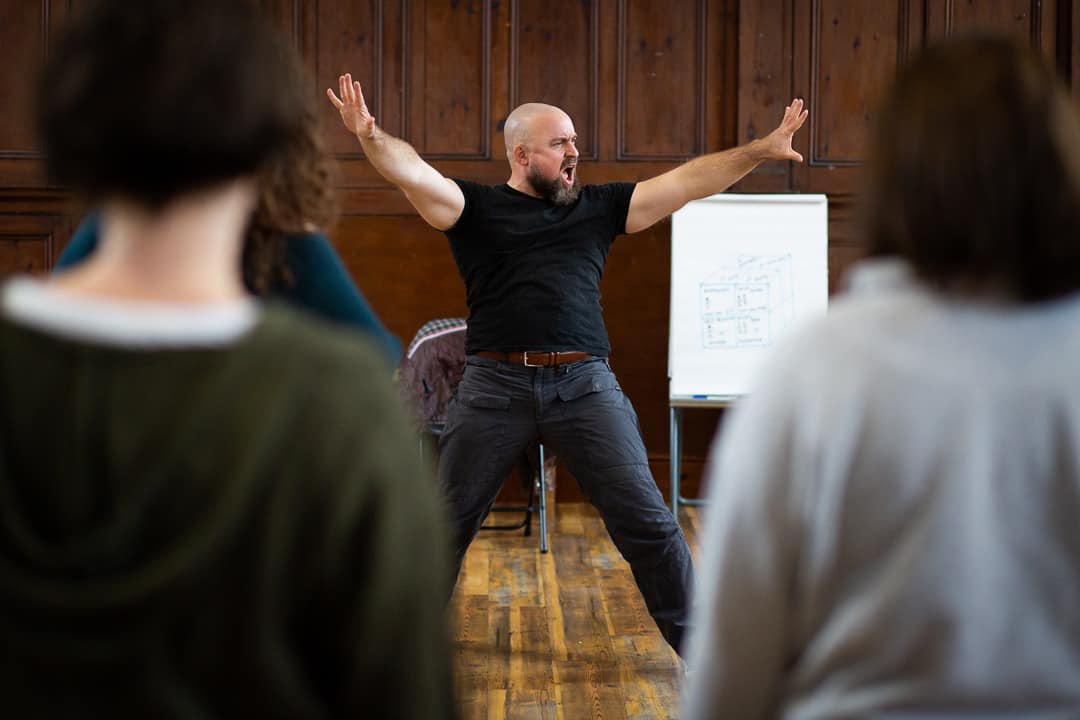
Live training
- 6-month live online training
- Weekly Tuesday live training calls
- Weekly recommended Thursday deeper-dive calls
- Live teaching and demonstrations
- Recordings access while we host the training platform
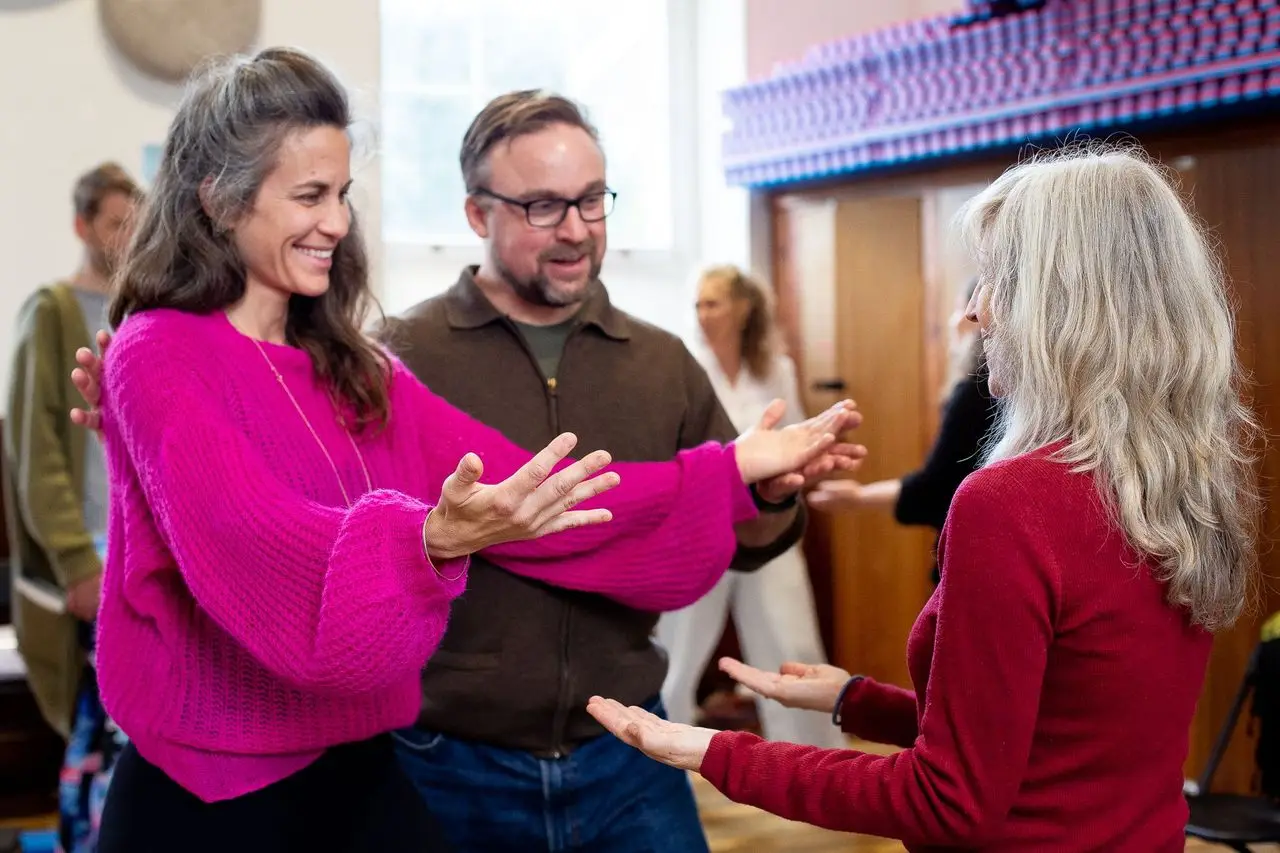
Practice and support
- Weekly peer group practice
- Guided embodied practice
- Practice between sessions
- Feedback from trainers and assistants
- Course manager and training support

Certification and tools
- 37 ICF CCE hours
- Body-based coaching tools and practice materials
- Assessment and completion standards
- Certification of Embodiment Coaching
Why we run CEC...
The full curriculum is here for people who want the detail.
Most people do not need to memorise the weeks. The point is the arc: build your own embodiment, then bring the work into coaching and facilitation.
Exact details may shift slightly. The arc stays the same.
Personal skills
Week 0: Pre-course work
Orientation, preparation and first practice.
Week 1: Opening
Set up the training, meet the group and begin the practice.
Week 2: Embodied learning
How adults learn embodiment, and why practice beats theory.
Week 3: Embodied awareness
Attention, sensation, body awareness and noticing what is already happening.
Week 4: Nervous system regulation
Working with state, activation, settling and capacity.
Week 5: 4 Elements Model
A practical map for range, state and embodied choice.
Week 6: Embodied Toolkit
Simple body-based tools for centring, state and practice.
Week 7: Cycles and change
How change happens, why people repeat patterns, and what helps shift them.
Week 8: Embodied relating
Working with connection, distance, boundaries and relationship.
Week 9: Centring challenge
Practice, repetition and making centring usable under pressure.
Professional skills
Week 10: Opening and ethics
Starting the professional skills phase, with scope, consent and clean practice.
Week 11: The coaching relationship
Presence, trust, listening and what happens between coach and client.
Week 12: Essential tools for coaches
Core tools for bringing the body into coaching conversations.
Week 13: Frameworks and goal setting
Useful structure without turning coaching into a form-filling exercise.
Week 14: Awareness Pointing Technique
Helping clients notice what is happening in the body, cleanly and practically.
Week 15: Embodied beliefs
Working with beliefs as lived patterns, not just nice sentences in the head.
Week 16: Practice
Coached practice, feedback and cleaning up the basics.
Week 17: 4 Elements Bodystorming
Using the 4 Elements model creatively with client situations.
Week 18: Embodied Toolkit
More practice with body-based tools and when to use them.
Week 19: Practice
More practice with live coaching situations and feedback.
Week 20: Leader-Follower in Coaching
Working with direction, following, influence and relational dynamics.
Week 21: Practice and Q&A
Questions, practice and fixing what is not yet working.
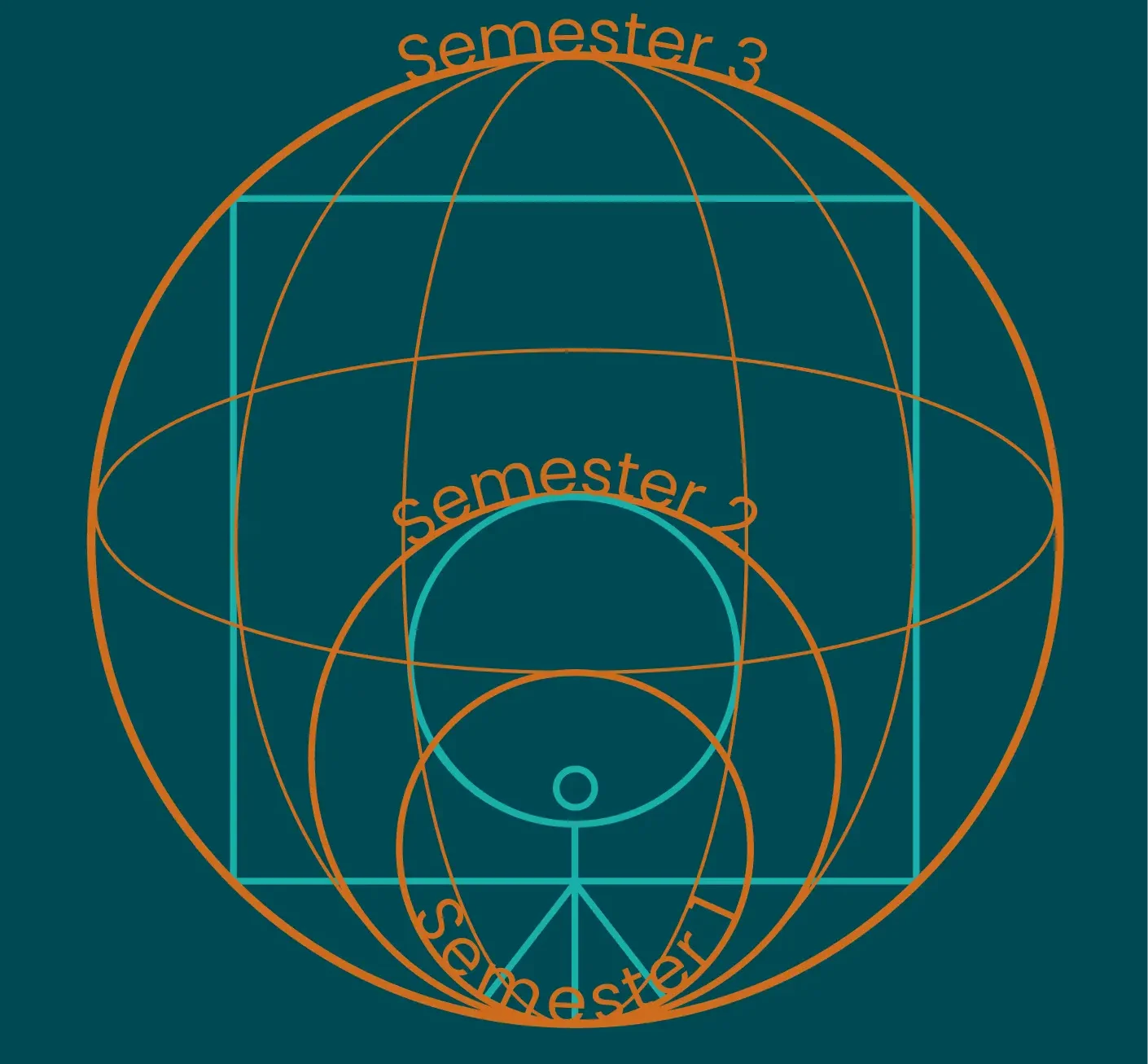
Week 22: The 3 Semesters of Coaching
A bigger map for the stages and development of coaching work.
Week 23: Designing a Great Workshop
Turning embodiment tools into useful group learning.
Week 24: Group Coaching Applications
Using embodied methods in group coaching and facilitation.
Week 25: Creativity in Embodied Facilitation
Making the work alive, useful and not weird for the sake of it.
Week 26: Self-Care for Coaches
Keeping yourself resourced, clear and useful as a practitioner.
Week 27: Graduation
Completion, certification and next steps.
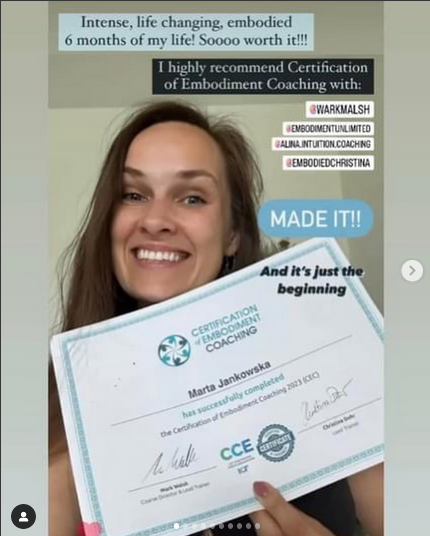
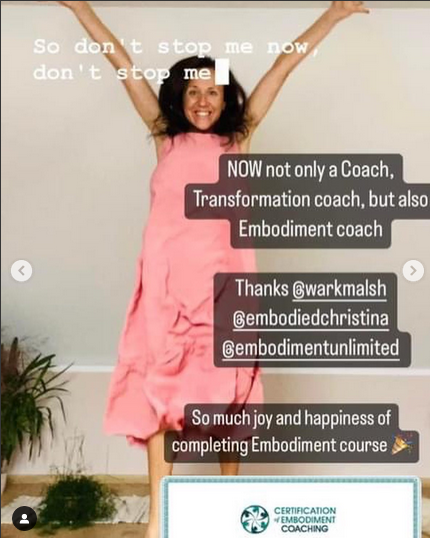
Join by July 24 and get these extras
These are included if you enrol by July 24.
The training is the main thing. These extras help you start well, practise properly and apply the work in the real world.
1-to-1 welcome call with Mark
A private call to clarify your focus, discuss how you want to use CEC, and orient the training to your real-world context.
Printed practice journal
A physical journal delivered to your door, designed to support weekly practice, reflection and integration away from screens.
Coaching marketing masterclasses
Practical sessions on pricing, boundaries and finding clients without being pushy or salesy.
Especially useful if you are building a private practice.
$500 learning voucher
A $500 credit to personalise your learning after CEC.
Use it towards eligible Embodiment Unlimited courses on boundaries, purpose, relationships, embodiment tools or other specialist areas that fit your coaching direction.
Schedule and enrolment
CEC is a 6-month, live online course starting September 15.
Upon graduation you will receive the Certification of Embodiment Coaching along with 37 ICF CCE hours.


xxx
- 37 ICF CCE hours
- 6-month live online certification
- Coach safely & effectively
We’ll send the session details and replay access by email.
Signup form not loading? Register here.
Questions people usually ask
Who is this event for?
Coaches, facilitators, therapists who coach, trainers, leadership practitioners, somatic practitioners, yoga or movement teachers moving toward coaching, and serious aspiring coaches.
It is especially relevant if you work with people who overthink, freeze, people-please, mask, collapse, shut down, or understand their patterns but still struggle to change them.
Is the event free?
Yes. The live event is free to register for, and replays will be available free from July 17-19.
Will there be replays?
Yes. Replays will be available free from July 17-19.
Watching live is better if you can, but we realise people have jobs, children, time zones and nervous systems.
How long are the sessions?
Most sessions are around 30 minutes, with an optional 15 minutes afterwards for questions, extra practice or discussion where useful.
What time are the sessions?
The live sessions run from July 14-16.
The programme includes UK morning, UK afternoon and US-friendly evening slots.
The event page shows each session in your local time, with the UK time underneath for reference.
Is this for coaches or therapists?
Primarily coaches, facilitators and practitioners who use coaching skills.
Therapists who also coach are welcome, especially if they want clearer ways to separate body-based coaching from therapy. The event will stay within coaching scope.
Is this about somatic coaching?
Yes, broadly. We usually use the word embodiment because it includes the body, behaviour, state, relationships, posture, breath, attention, movement and practical action.
If you are interested in somatic coaching, body-based coaching tools or nervous-system-informed coaching, this event should be relevant.
Is this trauma-informed?
It is trauma-aware, practical and careful about scope.
This is not a therapy training, and the event will not teach people to process trauma. It will explore how coaches can work more safely with the body, state, pacing, consent and regulation.
Is this useful for coaching neurodivergent or highly sensitive clients?
Often, yes – as long as it is kept within coaching scope.
Many neurodivergent, highly sensitive or overwhelmed clients are not helped by more pressure, advice or purely cognitive reflection. State, pacing, sensory load, masking, shame, boundaries and nervous-system regulation can all matter.
This event will not make you a neurodivergence specialist. It will give useful embodiment distinctions for working with more sensitivity and complexity.
Do I need embodiment experience?
No. Some experience helps, but you do not need to be an embodiment expert.
You do need curiosity, willingness to practise a little, and ideally a sense of humour about being human in a body.
Will this be practical?
Yes. Expect distinctions, examples, tools and demonstrations.
There will be ideas, because sadly humans still need those, but the event is not designed as a theory lecture.
How does this relate to the Certification of Embodiment Coaching?
The free event gives you a practical taste of the work.
The Certification of Embodiment Coaching (CEC) is the deeper six-month training for people who want to learn embodiment coaching properly, with live practice, feedback, support and clear standards.
You do not need to be ready for that now. Start with the free event.
Ready to train this properly?
The free event gives you the taste.
CEC is where you practise, get feedback and build the skills over six months.
If this is your work, join the next training.